
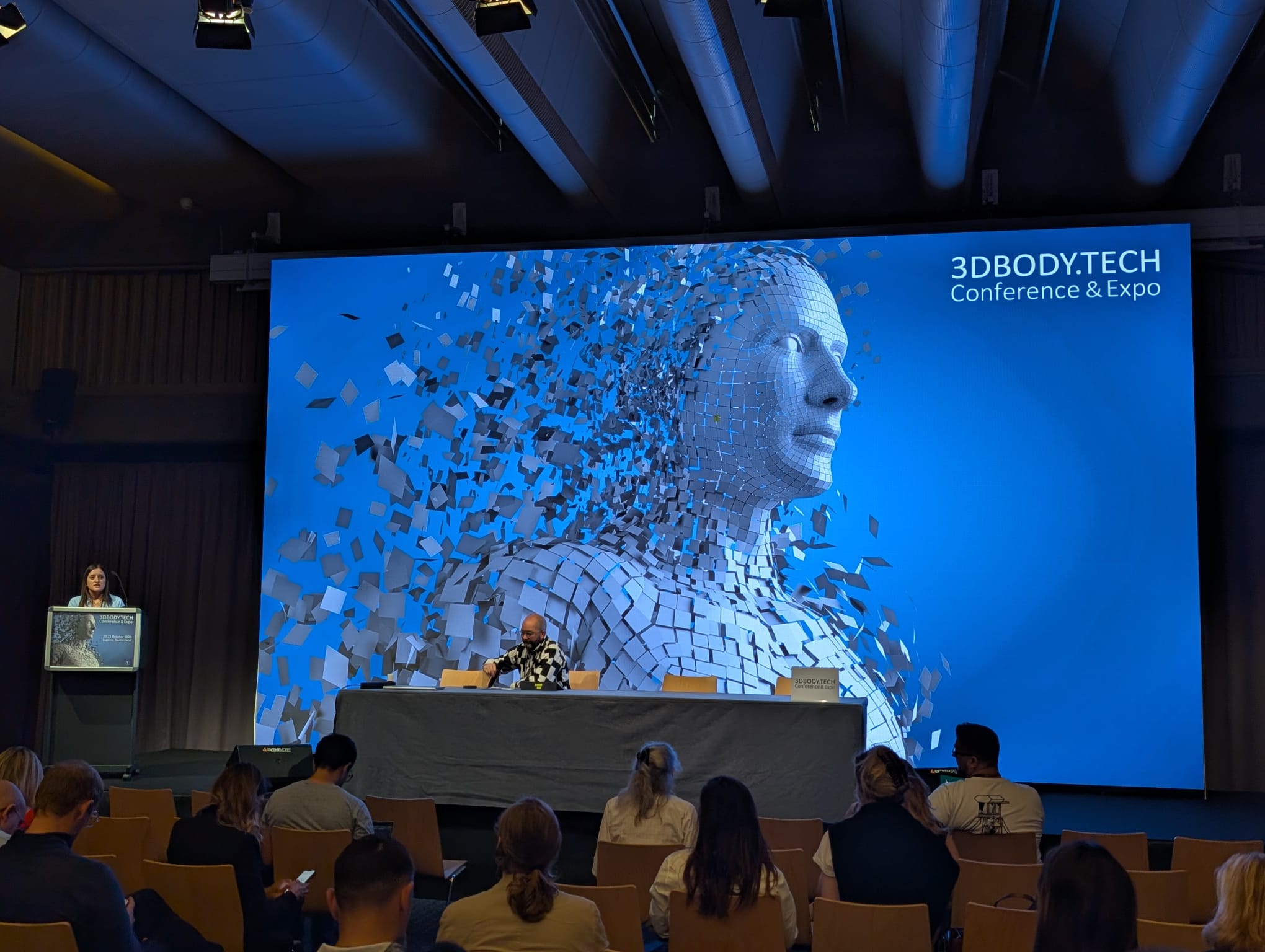
The 17th edition of 3DBODY.TECH brought together the international body-scanning community in Lugano, Switzerland, to explore the latest developments in 3D and 4D technologies. Among the key themes were mobile scanning, AI-powered body modelling, digital avatars and new applications in sports and apparel — areas closely connected to Avatar’s vision of making body data actionable.
On 20–21 October 2026, the international 3DBODY.TECH Conference & Expo returned to Lugano, Switzerland, bringing together researchers, technology developers, companies and professionals working at the forefront of human body scanning and digitalisation.
With more than 80 technical and scientific presentations, live demonstrations and an exhibition of scanning technologies, the event provided a broad overview of how 3D and 4D body technologies are evolving — and, importantly, how they are moving from technical demonstrations towards practical applications.
For Avatar, participating in this international meeting was an opportunity to exchange knowledge, follow emerging developments and share our perspective on one of the most relevant challenges for the apparel industry: how can we turn digital body information into better-fitting, more personalized products?
3D and 4D scanning: From capturing the body to understanding it
The conference programme covered a wide range of technologies and applications, reflecting the multidisciplinary nature of body digitalisation.
Several major areas stood out:
1. More accessible and mobile body scanning
Mobile, portable and handheld scanning solutions continue to expand the possibilities for capturing body information. By reducing dependence on dedicated scanning equipment, these technologies can make anthropometric data collection more accessible in different environments — including at home, in retail settings and in professional applications.
This is particularly relevant for e-commerce and personalized products, where collecting reliable body information remotely can help connect the customer with the product more effectively.
2. AI and advanced body-data processing
Artificial intelligence and machine learning are increasingly relevant to the processing and interpretation of body data. Beyond generating a 3D representation, these technologies can help extract measurements, reconstruct body shape and transform visual information into structured data.
The challenge is not simply to generate a digital model, but to ensure that the resulting information is reliable, relevant and suitable for its intended application.
3. The evolution towards 4D: Understanding the body in motion
While 3D scanning provides a representation of the body’s shape and dimensions, 4D technologies introduce the dimension of time.
Through motion capture, dynamic scanning and volumetric capture, it becomes possible to study how the body changes position and moves over time. This opens up interesting opportunities in sports, ergonomics, healthcare and product development.
For sportswear in particular, this perspective is important: a garment must not only fit the body in a static position, but also support movement, comfort and functionality during activity.
4. Digital humans, avatars and virtual product experiences
Digital humans and body avatars are becoming an important link between physical body data and digital applications. Their potential extends across virtual fitting, digital fashion, product design, simulation and personalized customer experiences.
The value of an avatar therefore depends not only on its visual appearance, but also on the quality of the underlying body data and its ability to connect with other digital tools and workflows.
From body measurements to digital body models
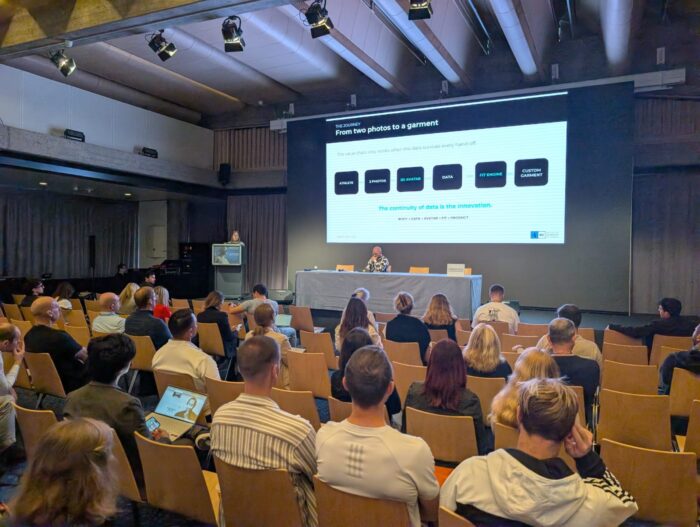
These developments were also at the centre of the presentation delivered by Beatriz Fernández, Innovation Manager at the Instituto de Biomecánica (IBV), entitled:
“From Body Scan to Custom Fit: Enabling Personalized Sportswear with 3D Avatar Body”.
The presentation addressed a fundamental limitation of conventional sizing systems: the human body does not come in S, M or L.
Two people wearing the same size can have very different body shapes, proportions and measurements. In sportswear, these differences can influence not only appearance, but also comfort, movement and the overall wearing experience.
Traditional anthropometric measurements provide valuable information, but each measurement describes only one dimension of the body. A digital body model offers a way to bring multiple measurements and body characteristics together in a single representation.
This is the approach behind 3D Avatar Body, IBV’s AI-based cloud service for full-body digitalisation.
Using just two photographs taken with a smartphone, the technology generates a 3D body avatar and provides more than 100 body measurements in less than a minute. This makes it possible to obtain structured anthropometric information without requiring a dedicated full-body scanning device.
The presentation highlighted four key characteristics that make a body avatar useful in real applications:
- Accessible: body capture using just two smartphone photographs.
- Scalable: a remote and repeatable process that can reach users in different locations.
- Actionable: body measurements and digital models that can support sizing, fit and product-related decisions.
- Integrable: the ability to connect body information with existing digital workflows and customer experiences.
The central message was clear: capturing body data is only the beginning. Its real value emerges when that information can be used to support decisions and improve products.
REGNA: Bringing personalized sportswear into practice
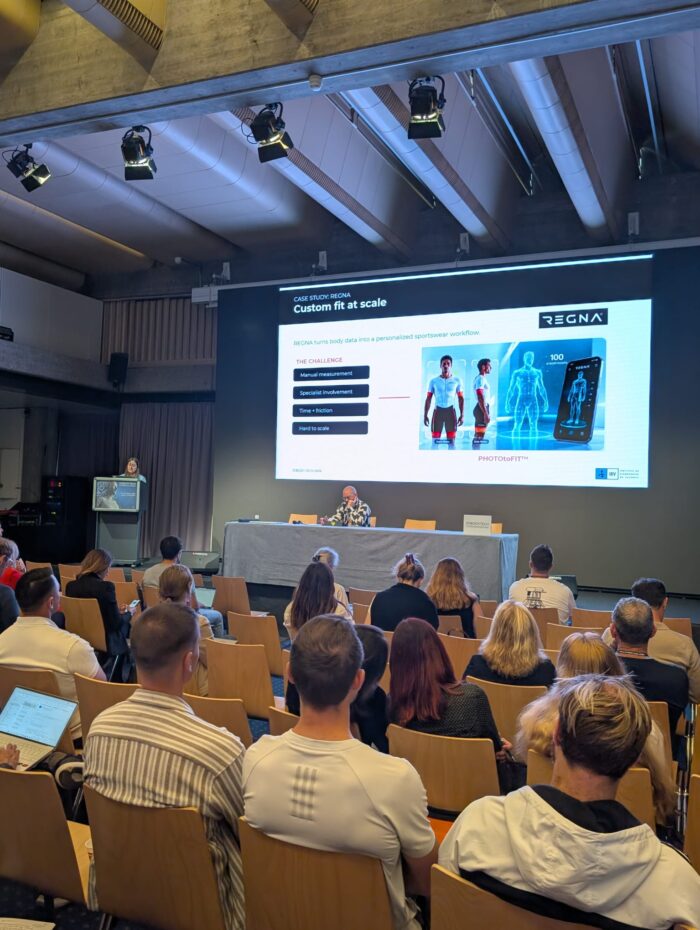
To illustrate how this approach can be applied in a real business environment, the presentation featured REGNA, a sportswear brand that has integrated IBV’s 3D Avatar Body technology into its personalized garment workflow through PHOTOtoFIT™.
In sports such as cycling and triathlon, garment fit can influence comfort, aerodynamics and performance. However, traditional manual measurement processes can be time-consuming and difficult to scale, particularly when serving customers remotely.
By connecting smartphone-based body capture with its custom-fit process, REGNA demonstrates how digital body information can become part of the customer journey — from the initial capture to the development of a personalized garment.
The public case-study narrative reports illustrative results including a 95% reduction in measurement time, a 35% reduction in returns and a 22% increase in average order value.
These figures highlight the potential business value of connecting body data with product and customer workflows. They also reinforce an important point: the impact of scanning technology should be assessed not only through measurement accuracy, but through the practical outcomes it helps enable.
One digital body, multiple opportunities
The developments discussed at 3DBODY.TECH point towards a broader opportunity for industries that rely on understanding the human body.
In apparel and sportswear, body avatars can support more personalized sizing and fit decisions. Looking further ahead, the same digital body representation could become a reusable source of information across different stages of the product lifecycle.
Potential applications include virtual fitting, dynamic sizing, digital product development and mass customization.
For these applications to become practical, however, several elements need to work together: reliable body data, suitable product information, integration with existing systems and a user experience that makes the process easy to adopt.
This is where the combination of biomechanics, AI, 3D modelling and application-specific expertise becomes especially important.
Making body data actionable
3DBODY.TECH 2026 once again highlighted the breadth of innovation taking place in 3D and 4D human body technologies — from new capture systems and dynamic analysis to AI-powered processing and digital avatars.
For Avatar, these developments reinforce a clear direction: the future of body scanning is not only about capturing the human body in greater detail. It is about making that information accessible, reliable and useful in real-world applications.
At IBV, this vision is reflected in the Avatar technology portfolio, which includes 3D Avatar Body, 3D Avatar Feet and DOMEscan/IBV — solutions designed to transform body and foot information into valuable data for sizing, fit, personalization and product development.
Because the next step in body digitalisation is not simply to create a digital version of every person.
It is to make that digital body useful — connecting people, data and products to create better-fitting, more personalized experiences.